Wednesday, 31 May 2017

Azure Interview Questions

Q.What is Azure Cloud Service?

By creating a cloud service, you can deploy a multi-tier web application in Azure, defining multiple roles to distribute processing and allow flexible scaling of your application. A cloud service consists of one or more web roles and/or worker roles, each with its own application files and configuration. Azure Websites and Virtual Machines also enable web applications on Azure. The main advantage of cloud services is the ability to support more complex multi-tier architectures
visit here for more Azure interview question

Q. What is a cloud service role?

A cloud service role is comprised of application files and a configuration. A cloud service can have two types of roles.

Q. What is link a resource?

To show your cloud service’s dependencies on other resources, such as an Azure SQL Database instance, you can “link” the resource to the cloud service. In the Preview Management Portal, you can view linked resources on the Linked Resources page, view their status on the dashboard, and scale a linked SQL Database instance along with the service roles on the Scale page. Linking a resource in this sense does not connect the resource to the application; you must configure the connections in the application code.

Q. What is scale a cloud service?

A cloud service is scaled out by increasing the number of role instances (virtual machines) deployed for a role. A cloud service is scaled in by decreasing role instances. In the Preview Management Portal, you can also scale a linked SQL Database instance, by changing the SQL Database edition and the maximum database size, when you scale your service roles.

Q. What is a web role?

A web role provides a dedicated Internet Information Services (IIS) web-server used for hosting front-end web applications.

Q.What is a worker role?

Applications hosted within worker roles can run asynchronous, long-running or perpetual tasks independent of user interaction or input.

Q. What is a role instance?

A role instance is a virtual machine on which the application code and role configuration run. A role can have multiple instances, defined in the service configuration file.

Q. What is a guest operating system?

The guest operating system for a cloud service is the operating system installed on the role instances (virtual machines) on which your application code runs.

Q. What is a cloud service components?

Three components are required in order to deploy an application as a cloud service in Azure:

Q. What is deployment environments?

Azure offers two deployment environments for cloud services: a staging environment in which you can test your deployment before you promote it to the production environment. The two environments are distinguished only by the virtual IP addresses (VIPs) by which the cloud service is accessed. In the staging environment, the cloud service’s globally unique identifier (GUID) identifies it in URLs (GUID.cloudapp.net). In the production environment, the URL is based on the friendlier DNS prefix assigned to the cloud service (for example, myservice.cloudapp.net).

Q. What is swap deployments?

To promote a deployment in the Azure staging environment to the production environment, you can “swap” the deployments by switching the VIPs by which the two deployments are accessed. After the deployment, the DNS name for the cloud service points to the deployment that had been in the staging environment.

Q. What is minimal vs. verbose monitoring?

Minimal monitoring, which is configured by default for a cloud service, uses performance counters gathered from the host operating systems for role instances (virtual machines). Verbose monitoring gathers additional metrics based on performance data within the role instances to enable closer analysis of issues that occur during application processing. For more information

Q. What is a service definition file?

The cloud service definition file (.csdef) defines the service model, including the number of roles.

Q. What is a service configuration file?

The cloud service configuration file (.cscfg) provides configuration settings for the cloud service and individual roles, including the number of role instances.

Q. What is a service package?

The service package (.cspkg) contains the application code and the service definition file.

Q. What is a cloud service deployment?

A cloud service deployment is an instance of a cloud service deployed to the Azure staging or production environment. You can maintain deployments in both staging and production.

Q. What is Azure Diagnostics?

Azure Diagnostics is the API that enables you to collect diagnostic data from applications running in Azure. Azure Diagnostics must be enabled for cloud service roles in order for verbose monitoring to be turned on.

Q. What is Azure Service Level Agreement (SLA)?

The Azure Compute SLA guarantees that, when you deploy two or more role instances for every role, access to your cloud service will be maintained at least 99.95 percent of the time. Also, detection and corrective action will be initiated 99.9 percent of the time when a role instance’s process is not running.

Q. What is Cloud Computing?

Cloud computing is the use of computing resources (hardware and software) that are delivered
as a service over a network (typically the Internet).

Q. What are the Service Model in Cloud Computing?

Cloud computing providers offer their services according to three fundamental models: Infrastructure as a service (IaaS), platform as a service (PaaS), and software as a service (SaaS) where IaaS is the most basic and each higher model abstracts from the details of the lower models.
Examples of IaaS include: Amazon CloudFormation (and underlying services such as Amazon EC2), Rackspace Cloud, Terremark, Windows Azure Virtual Machines, Google Compute Engine. and Joyent.
Examples of PaaS include: Amazon Elastic Beanstalk, Cloud Foundry, Heroku, Force.com, EngineYard, Mendix, Google App Engine, Windows Azure Compute and OrangeScape.
Examples of SaaS include: Google Apps, Microsoft Office 365, and Onlive. Source from : HTTP://EN.WIKIPEDIA.ORG/WIKI/CLOUD_COMPUTING

Q. How many types of deployment models are used in cloud?

There are 4 types of deployment models used in cloud:
  1. Public cloud
  2. Private cloud
  3. Community cloud
  4. Hybrid cloud

Q. What is Windows Azure Platform?

A collective name of Microsoft’s Platform as a Service (PaaS) offering which provides a programming platform, a deployment vehicle, and a runtime environment of cloud computing hosted in Microsoft datacenters.

Q. What are the roles available in Windows Azure?

All three roles (web, worker, VM) are essentially Windows Server 2008. Web and Worker roles are nearly identical: With Web and Worker roles, the OS and related patches are taken care for you; you build your app’s components without having to manage a VM

Q. What is difference between Windows Azure Platform and Windows Azure?

The former is Microsoft’s PaaS offering including Windows Azure, SQL Azure, and Appfabric; while the latter is part of the offering and the Microsoft’s cloud OS.

Q. What are the three main components of Windows Azure Platform?

  1. Compute
  2. Storage
  3. AppFabric

Q. What is Windows Azure compute emulator?

The compute emulator is a local emulator of Windows Azure that you can use to build and test your application before deploying it to Windows Azure.

Q. What is fabric?

In the Windows Azure cloud fabric is nothing but a combination of many virtualized instances which run client application

Q. How many instances of a Role should be deployed to satisfy Azure SLA (service level agreement) ? And what’s the benefit of Azure SLA?

TWO. And if we do so, the role would have external connectivity at least 99.95% of the time.

Q. What are the options to manage session state in Windows Azure?        

Windows Azure Caching
SQL Azure
Azure Table

Q. What is cspack?

It is a command-line tool that generates a service package file (.cspkg) and prepares an application for deployment, either to Windows Azure or to the compute emulator.

Q. What is csrun?

It is a command-line tool that deploys a packaged application to the Windows Azure compute emulator and manages the running service.

Q. What is guest OS?

It is the operating system that runs on the virtual machine that hosts an instance of a role.

Q. How to programmatically scale out Azure Worker Role instances?

Using AutoScaling Application Block

Q. What is the difference between Public Cloud and Private Cloud?

Public cloud is used as a service via Internet by the users, whereas a private cloud, as the name conveys is deployed within certain boundaries like firewall settings and is completely managed and monitored by the users working on it in an organization.

Q. How to design applications to handle connection failure in windows Azure?

The Transient Fault Handling Application Block supports various standard ways of generating the retry delay time interval, including fixed interval, incremental interval (the interval increases by a standard amount), and exponential back-off (the interval doubles with some random variation).
static RetryPolicy policy = new RetryPolicy(5, TimeSpan.FromSeconds(2), TimeSpan.FromSeconds(2)); policy.ExecuteAction(() => { try { string federationCmdText = @”USE FEDERATION Customer_Federation(ShardId =” + shardId + “) WITH RESET, FILTERING=ON”; customerEntity.Connection.Open(); customerEntity.ExecuteStoreCommand(federationCmdText); } catch (Exception e) { customerEntity.Connection.Close(); SqlConnection.ClearAllPools(); } });

Q. What is windows Azure Diagnostics?

Windows Azure Diagnostics enables you to collect diagnostic data from an application running in Windows Azure. You can use diagnostic data for debugging and troubleshooting, measuring performance, monitoring resource usage, traffic analysis and capacity planning, and auditing. HTTP://WWW.WINDOWSAZURE.COM/EN-US/DEVELOP/NET/COMMON-TASKS/DIAGNOSTICS/

Q. What is Blob?

BLOB stands for Binary Large Object. Blob is file of any type and size.
The Azure Blob Storage offers two types of blobs –
  1. Block Blob
  2. Page Blob
URL format: Blobs are addressable using the following URL format:

Q. What is the difference between Block Blob vs Page Blob?

Block blobs are comprised of blocks, each of which is identified by a block ID.
You create or modify a block blob by uploading a set of blocks and committing them by their block IDs.
If you are uploading a block blob that is no more than 64 MB in size, you can also upload it in its entirety with a single Put Blob operation. -Each block can be a maximum of 4 MB in size. The maximum size for a block blob in version 2009-09-19 is 200 GB, or up to 50,000 blocks.
Page blobs are a collection of pages. A page is a range of data that is identified by its offset from the start of the blob. To create a page blob, you initialize the page blob by calling Put Blob and specifying its maximum size.
-The maximum size for a page blob is 1 TB. A page written to a page blob may be up to 1 TB in size.
what to use block blobs for: streaming video. “The application must provide random read/write access” which is supported by Page Blobs

Q. What is the difference between Windows Azure Queues and Windows Azure Service Bus Queues?

Windows Azure supports two types of queue mechanisms: Windows Azure Queues and Service Bus Queues.
Windows Azure Queues, which are part of the Windows Azure storage infrastructure, feature a simple REST-based Get/Put/Peek interface, providing reliable, persistent messaging within and between services.
Service Bus Queues are part of a broader Windows Azure messaging infrastructure that supports queuing as well as publish/subscribe, Web service remoting, and integration patterns.

Q. What is DeadLetter queue?

  • Messages are placed on the deadletter sub-queue by the messaging system in the following scenarios.
  • When a message expires and deadlettering for expired messages is set to true in a queue or subscription.
  • When the max delivery count for a message is exceeded on a queue or subscription.
  • When a filter evaluation exception occurs in a subscription and deadlettering is enabled on filter evaluation exceptions.

Q. What are instance sizes of Azure?

Windows Azure will handle the load balancing for all of the instances that are created. The VM sizes are as follows:
Compute Instance Size CPU Memory Instance Storage I/O Performance
Extra Small 1.0 Ghz 768 MB 20 GB Low
Small 1.6 GHz 1.75 GB 225 GB Moderate
Medium 2 x 1.6 GHz 3.5 GB 490 GB High
Large 4 x 1.6 GHz 7 GB 1,000 GB High
Extra large 8 x 1.6 GHz 14 GB 2,040 GB High

Data Modelling

Data modeling in software engineering is the process of creating a data model for an information system by applying certain formal techniques.
Image result for data modelling icon
Data modeling is a process used to define and analyze data requirements needed to support the business processes within the scope of corresponding information systems in organizations. Therefore, the process of data modeling involves professional data modelers working closely with business stakeholders, as well as potential users of the information system.
There are three different types of data models produced while progressing from requirements to the actual database to be used for the information system. The data requirements are initially recorded as a conceptual data model which is essentially a set of technology independent specifications about the data and is used to discuss initial requirements with the business stakeholders. The conceptual model is then translated into a logical data model, which documents structures of the data that can be implemented in databases. Implementation of one conceptual data model may require multiple logical data models. The last step in data modeling is transforming the logical data model to a physical data model that organizes the data into tables, and accounts for access, performance and storage details. Data modeling defines not just data elements, but also their structures and the relationships between them.

Data modeling techniques and methodologies are used to model data in a standard, consistent, predictable manner in order to manage it as a resource. The use of data modeling standards is strongly recommended for all projects requiring a standard means of defining and analyzing data within an organization, e.g., using data modeling:
  • to assist business analysts, programmers, testers, manual writers, IT package selectors, engineers, managers, related organizations and clients to understand and use an agreed semi-formal model the concepts of the organization and how they relate to one another
  • to manage data as a resource
  • for the integration of information systems
  • for designing databases/data warehouses (aka data repositories)

Data modeling may be performed during various types of projects and in multiple phases of projects. Data models are progressive; there is no such thing as the final data model for a business or application. Instead a data model should be considered a living document that will change in response to a changing business. The data models should ideally be stored in a repository so that they can be retrieved, expanded, and edited over time. Whitten et al. (2004) determined two types of data modeling:
  • Strategic data modeling: This is part of the creation of an information systems strategy, which defines an overall vision and architecture for information systems is defined. Information engineering is a methodology that embraces this approach.
  • Data modeling during systems analysis: In systems analysis logical data models are created as part of the development of new databases.
Data modeling is also used as a technique for detailing business requirements for specific databases. It is sometimes called database modeling because a data model is eventually implemented in a database.
Data modeling topics
Data models
Main article: Data model
How data models deliver benefit.
Data models provide a structure for data used within information systems by providing specific definition and format. If a data model is used consistently across systems then compatibility of data can be achieved. If the same data structures are used to store and access data then different applications can share data seamlessly. The results of this are indicated in the diagram. However, systems and interfaces are often expensive to build, operate, and maintain. They may also constrain the business rather than support it. This may occur when the quality of the data models implemented in systems and interfaces is poor.
  • Business rules, specific to how things are done in a particular place, are often fixed in the structure of a data model. This means that small changes in the way business is conducted lead to large changes in computer systems and interfaces. So, business rules need to be implemented in a flexible way that does not result in complicated dependencies, rather the data model should be flexible enough so that changes in the business can be implemented within the data model in a relatively quick and efficient way.
  • Entity types are often not identified, or are identified incorrectly. This can lead to replication of data, data structure and functionality, together with the attendant costs of that duplication in development and maintenance.Therefore, data definitions should be made as explicit and easy to understand as possible to minimize misinterpretation and duplication.
  • Data models for different systems are arbitrarily different. The result of this is that complex interfaces are required between systems that share data. These interfaces can account for between 25-70% of the cost of current systems. Required interfaces should be considered inherently while designing a data model, as a data model on its own would not be usable without interfaces within different systems.
  • Data cannot be shared electronically with customers and suppliers, because the structure and meaning of data has not been standardised. To obtain optimal value from an implemented data model, it is very important to define standards that will ensure that data models will both meet business needs and be consistent
Conceptual, logical and physical schemas
In 1975 ANSI described three kinds of data-model instance:
  • Conceptual schema: describes the semantics of a domain (the scope of the model). For example, it may be a model of the interest area of an organization or of an industry. This consists of entity classes, representing kinds of things of significance in the domain, and relationships assertions about associations between pairs of entity classes. A conceptual schema specifies the kinds of facts or propositions that can be expressed using the model. In that sense, it defines the allowed expressions in an artificial “language” with a scope that is limited by the scope of the model. Simply described, a conceptual schema is the first step in organizing the data requirements.
  • Logical schema: describes the structure of some domain of information. This consists of descriptions of (for example) tables, columns, object-oriented classes, and XML tags. The logical schema and conceptual schema are sometimes implemented as one and the same.
  • Physical schema: describes the physical means used to store data. This is concerned with partitions, CPUs, tablespaces, and the like.
According to ANSI, this approach allows the three perspectives to be relatively independent of each other. Storage technology can change without affecting either the logical or the conceptual schema. The table/column structure can change without (necessarily) affecting the conceptual schema. In each case, of course, the structures must remain consistent across all schemas of the same data model.

Data modeling process
Data modeling in the context of Business Process Integration.
In the context of business process integration (see figure), data modeling complements business process modeling, and ultimately results in database generation.
The process of designing a database involves producing the previously described three types of schemas – conceptual, logical, and physical. The database design documented in these schemas are converted through a Data Definition Language, which can then be used to generate a database. A fully attributed data model contains detailed attributes (descriptions) for every entity within it. The term “database design” can describe many different parts of the design of an overall database system. Principally, and most correctly, it can be thought of as the logical design of the base data structures used to store the data. In the relational model these are the tables and views. In an object database the entities and relationships map directly to object classes and named relationships. However, the term “database design” could also be used to apply to the overall process of designing, not just the base data structures, but also the forms and queries used as part of the overall database application within the Database Management System or DBMS.
In the process, system interfaces account for 25% to 70% of the development and support costs of current systems. The primary reason for this cost is that these systems do not share a common data model. If data models are developed on a system by system basis, then not only is the same analysis repeated in overlapping areas, but further analysis must be performed to create the interfaces between them. Most systems within an organization contain the same basic data, redeveloped for a specific purpose. Therefore, an efficiently designed basic data model can minimize rework with minimal modifications for the purposes of different systems within the organization

Modeling methodologies
Data models represent information areas of interest. While there are many ways to create data models, according to Len Silverston (1997) only two modeling methodologies stand out, top-down and bottom-up:
  • Bottom-up models or View Integration models are often the result of a reengineering effort. They usually start with existing data structures forms, fields on application screens, or reports. These models are usually physical, application-specific, and incomplete from an enterprise perspective. They may not promote data sharing, especially if they are built without reference to other parts of the organization.
  • Top-down logical data models, on the other hand, are created in an abstract way by getting information from people who know the subject area. A system may not implement all the entities in a logical model, but the model serves as a reference point or template.
Sometimes models are created in a mixture of the two methods: by considering the data needs and structure of an application and by consistently referencing a subject-area model. Unfortunately, in many environments the distinction between a logical data model and a physical data model is blurred. In addition, some CASE tools don’t make a distinction between logical and physical data models.

Contact Info:
Mindmajix Technologies Inc
USA : +1-201 3780 518
IND : +91 9246333245
Email: info@mindmajix.com

Team Foundation Server

Team Foundation Server (commonly abbreviated to TFS) is a Microsoft product that provides source code management (either with Team Foundation Version Control or Git), reporting, requirements management, project management (for both agile software development and waterfall teams), automated builds, lab management, testing and release management

capabilities.

It covers the entire application life cycle, and enables DevOps capabilities. TFS can be used as a back-end to numerous integrated development environments (IDEs) but is tailored for Microsoft Visual Studio and Eclipse on all platforms

Online vs On-premises

Team Foundation Server is available in two different forms: on-premises and online. The latter form is called Visual Studio Team Services (formerly Visual Studio Online). The cloud service is backed by Microsoft’s cloud platform, Microsoft Azure.
It uses the same code as the on-premises version of TFS, with minor modifications, and implements the most recent features.
Visual Studio Team Services requires no setup. A user signs in using a Microsoft account to set up an environment, creating projects and adding team members. New features developed in short development cycles are added to the cloud version first. These features migrate to the on-premises version as updates, at approximately three-month intervals

Architecture

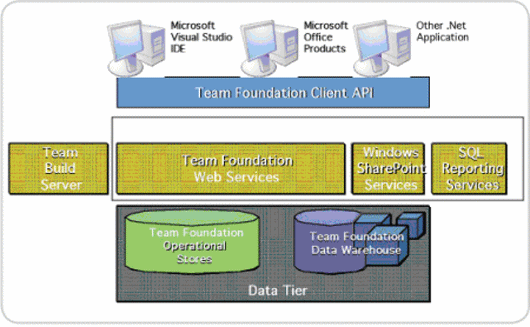
The following major features are included in Team Foundation Server:
  • Version control, for managing source code and other deliverables that require versioning.
  • Work item tracking, for keeping track of such things as defects, requirements, tasks, and scenarios.
  • Project management functions, which allow the shaping of a team project based on a user-specifiable software process, and which enable planning and tracking using Microsoft Excel and Microsoft Project.
  • Team build, for enabling a common process for building executable products.
  • Data collection and reporting, which aid in the assessment of a team project’s state, based on information gleaned from Team Foundation Server tools.
  • The Team Project Portal, which provides a central point of communication for a team project packaged as a Microsoft Windows SharePoint Services site.

  • Team Foundation Shared Services, which provide a number of common infrastructure services that invisible to end users but that are important to toolsmiths and extenders.
For TFS online Training visit: mindmajix/TFS training
Contact Info:
Mindmajix Technologies Inc
USA : +1-201 3780 518
IND : +91 9246333245
Email: info@mindmajix.com

What is  SAP Business One?

       SAP Business One is A single, integrated and affordable ERP solution for smaller businesses

SAP Business One, developed by SAP, has been built from the ground up for small to medium sized businesses that have outgrown their accounting-only or legacy systems and are looking for a single, integrated solution to manage their entire business

This specific ERP solution provides executives and managers with instant access to critical business information so they can confidently make informed business decisions, and offers more than just accounting

SAP Business One is a comprehensive solution that covers virtually all aspects of your business including finance, logistics/operations and customer relationship management.

Some of the SAP Business One Features

Accounting and financials – Manage your general ledger, journals, budgets, and accounts receivables and payables
  • Sales and customer relationship management – Manage the entire sales process from first contact to closing the sale and from customer data management to after sales support
  • Purchasing and operations – Control the entire procurement process
  • Inventory and distribution – Manage inventory across multiple warehouses and locations, and track and record stock movements
  • Reporting and administration – Create, manage, and distribute reports that help foster clarity in your business
some of the SAP Business One Benefits
  •  Spend more time growing your business using newly streamlined operations instead of reacting to details of day-to-day tasks
  • Respond quickly to customer needs by instantly accessing the information necessary to make confident business decisions
  • Eliminate redundant data entry and errors with a single, integrated system that improves process efficiency, minimizes costs and delays, and strengthens your bottom line
  • Form closer customer relationships via centralized information that makes it easier to manage customer communication and sales contracts
  • Lower your technology costs and achieve faster time to value by using a system that can be implemented quickly, is uncomplicated to maintain, and minimizes end-user training

Pay scale for SAP Business One Consultant
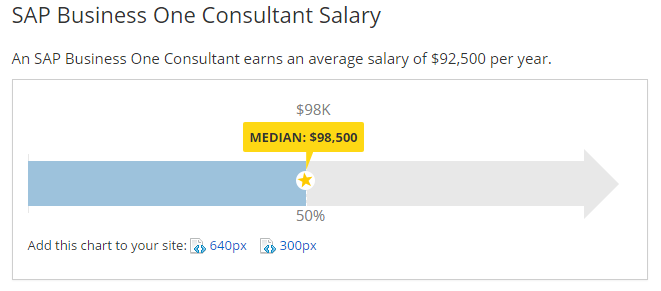
An SAP Business One Consultant earns an average salary of $92,500 per year.
source:payscale
Where can I find the best place to get trained on SAP business one
 MindMajix is the leader in delivering online courses training for wide-range of IT software courses like SAP business one
Contact Mindmajix For information on SAP business one
Mindmajix Technologies Inc
USA : +1-201 3780 518
IND : +91 9246333245